
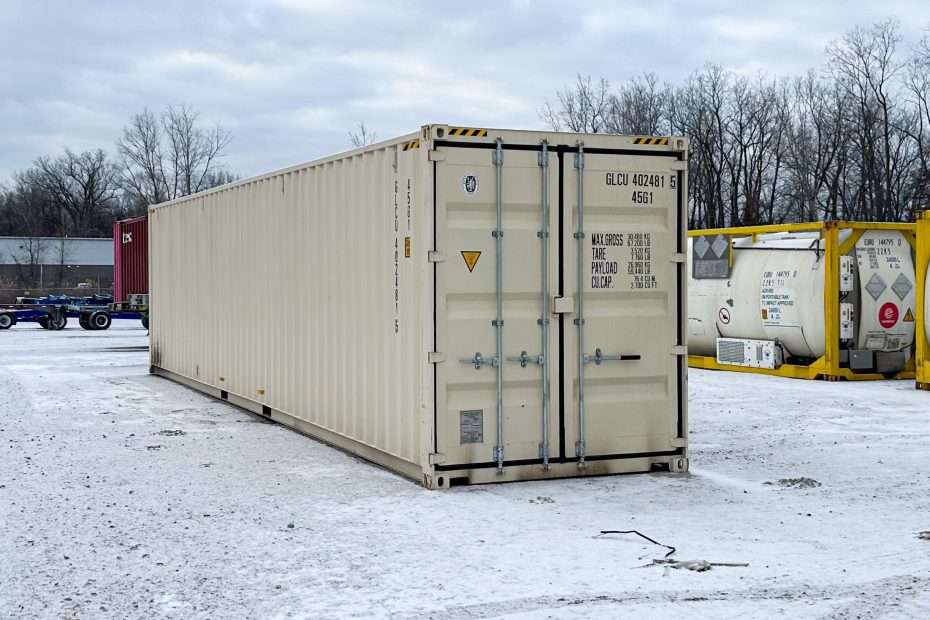
WINTER WARNING: A shipping container roof is not the same as a residential building roof. Before Michigan’s first major snowfall, inspect the container, identify your local snow-load requirement, and plan reinforcement or snow removal where necessary.
THE SHORT ANSWER: ABOUT 31 PSF ON A BARE ISO ROOF
A healthy, unmodified ISO shipping container roof is commonly evaluated at approximately 31 PSF OF UNIFORM DISTRIBUTED LOAD on the corrugated roof panels.
That figure is a conservative engineering interpretation of the ISO roof test, not a universal manufacturer guarantee for every container, age, condition, or modification.
The ISO 1496-1 roof test requires a container roof to withstand approximately:
- 300 kg / 660 lb test load
- Applied over approximately 600 mm x 300 mm
- At the roof’s weakest point
- Without unacceptable deformation
A shipping container is engineered primarily for:
- Stacking
- Lifting
- Racking resistance
- Cargo protection
- Load transfer through the corner posts and corner castings
The corrugated roof panels are NOT DESIGNED AS A STRUCTURAL DECK for deep snow, rooftop equipment, or regular foot traffic.
WHY THE CORNER CASTINGS MATTER
The strongest vertical load path runs through the:
- Top corner castings
- Corner posts
- Bottom corner castings
- Foundation or support blocks
A new roof system, canopy, or engineered reinforcement should transfer snow loads through the container’s structural frame, not simply press more weight onto the thin corrugated roof sheet.
MICHIGAN SNOW LOAD REALITY
Michigan’s required design loads vary substantially by county and jurisdiction. The Michigan Building Code uses Table 1608.3, Michigan Ground Snow Loads by Jurisdiction. Comparable residential requirements appear in Mich. Admin. Code R 408.30515.
Review the current Michigan ground snow-load table for the exact city, township, or village where the container will be installed.
General ranges:
| Michigan Area | Typical Ground Snow Load |
|---|---|
| Southern Lower Peninsula | 20–35 PSF |
| Central Lower Peninsula | 30–50 PSF |
| Northern Lower Peninsula | 40–70 PSF |
| Upper Peninsula | 60–90 PSF |
| Houghton and Keweenaw County areas | 70–100 PSF |
Examples from the code table:
- Wayne County: generally 20 PSF
- Genesee County: generally 30 PSF, with local variations
- Ottawa County: generally 50 PSF, with local variations
- Alger County: 70 PSF
- Houghton County: 70–90 PSF
- Keweenaw County: 90–100 PSF in certain jurisdictions
GROUND SNOW LOAD IS NOT THE SAME AS ROOF SNOW LOAD.
Roof design snow load is calculated from ground snow load using factors for:
- Exposure
- Thermal conditions
- Roof slope
- Importance
- Drift and unbalanced accumulation
A flat container roof may have a lower balanced roof load than the ground-load value. However, drift accumulation, adjacent buildings, wind exposure, and melting/refreezing can create concentrated loads that are higher than the basic calculation.
For an occupied conversion, have a Michigan-licensed structural engineer verify the complete roof design.
HOW HEAVY IS MICHIGAN SNOW?
Snow density changes quickly.
Approximate weight:
- Dry powder: light
- Compacted snow: substantially heavier
- Wet heavy snow: approximately 10–20 LB PER CUBIC FOOT
- Slush or ice: potentially much heavier than wet snow
A uniform 12-inch layer of wet snow can approach 10–20 PSF, depending on moisture content. A thaw followed by refreezing can create dense, bonded snow and ice that is much harder to remove.
Do not judge roof risk by depth alone. A shallow layer of saturated snow may weigh more than a deeper layer of dry powder.
ROOF INSPECTION BEFORE THE FIRST FREEZE
Complete this inspection before winter:
-
Check the roofline
Look for a straight, slightly crowned profile. A wavy, dished, or visibly sagging roof requires professional evaluation. -
Inspect roof seams
Look for separated seams, failed sealant, popped fasteners, and water staining. -
Check for rust pinholes
Surface rust is not the same as structural corrosion. Pay attention to pinholes, thinning steel, and rust along roof edges. -
Inspect the coating
Damaged or peeling coating exposes the steel to moisture and freeze-thaw corrosion. -
Open and close both doors
New door alignment problems can indicate frame movement, foundation settlement, or structural distortion. -
Check the floor and supports
Keep the container supported at the corners and properly leveled. Twisted support points can affect door operation and frame alignment.

WARNING SIGNS OF OVERSTRESS
Stop loading the roof and arrange a professional inspection if you see:
- Roof panel deflection
- A wavy or “dished” roofline
- Water pooling after snowmelt
- Doors that no longer align or latch correctly
- Popped seams or separated welds
- New leaks after a snow event
- Increasing condensation inside
- Buckled top rails
- Cracks or movement around modified openings
DO NOT WALK ON A VISIBLY DISTRESSED ROOF. A roof that has already deformed may not safely support a person.
SAFE SNOW REMOVAL PRACTICES
For a healthy container with no visible structural problems:
- Use a plastic roof rake or plastic shovel.
- Work from the ground whenever possible.
- Use fall protection if roof access is unavoidable.
- Never use a metal shovel on coated steel.
- Remove snow in manageable layers.
- Do not make one large push that overloads the opposite roof edge.
- Avoid concentrating your weight in the center of the roof.
- Keep snow from piling against nearby walls, fences, or structures.
- Do not leave a thick, uniform blanket after removing only part of the roof.
- Never remove snow from a roof showing deflection, pooling, or door-alignment problems.
When in doubt, contact a qualified contractor or structural professional. Snow removal can create a fall hazard and can damage the roof if performed aggressively.
DRIFTING, ICE DAMS, AND MELTWATER
Snow does not always accumulate evenly.
Common problem areas:
- The side of a container facing a taller building
- The gap between two containers
- Areas beneath roof overhangs
- Walls near fences or tree lines
- The downwind side of the container
- Roof edges where snow slides and refreezes
Container doors also require attention. Ice can form around door gaskets and locking-bar channels, causing:
- Frozen doors
- Damaged gaskets
- Water intrusion
- Misalignment
- Difficulty opening the unit during an emergency
Clear snow away from the door area without striking the gasket or locking hardware. Do not force frozen doors with a vehicle or heavy equipment.
REINFORCEMENT OPTIONS
ENGINEERED PEAKED ROOF KIT
A peaked or single-slope roof installed above the container sheds snow and water more effectively than the original flat roof profile.
The roof system should:
- Be designed for the site’s Michigan snow load
- Include adequate slope
- Transfer loads to the corner castings or top rails
- Account for wind and drift conditions
- Include proper flashing and drainage
INTERNAL RAFTER STIFFENERS
Internal steel rafters can reduce the unsupported span of the roof panels. They are especially relevant when the container will be insulated, heated, or converted into a workshop or occupied space.
SPREADER BEAMS
Spreader beams or secondary framing can distribute load across stronger structural members. Placement and connections require engineering review.
PARTIAL SHELTER
A partially sheltered location may reduce direct accumulation, but it does not eliminate snow-load risk. Shelters can also create drift zones. Do not place a container beneath a roof edge where snow can slide onto it.
REINFORCE BEFORE WINTER
Reinforcement is easier and safer before heavy snow, ice, and frozen ground arrive. Mid-February repairs are more difficult, more expensive, and more hazardous.
OCCUPIED CONVERSIONS REQUIRE A HIGHER STANDARD
A container used for basic outdoor storage is different from a container converted into:
- An office
- A workshop
- A hunting cabin
- A residence
- A retail space
- A public-access building
A converted container must meet the building-code requirements for its jurisdiction, including applicable snow, wind, fire, insulation, electrical, and egress requirements.
The bare ISO roof does NOT AUTOMATICALLY MEET MICHIGAN BUILDING CODE SNOW LOADS in many locations, particularly northern Michigan and the Upper Peninsula.
Before cutting doors, adding windows, installing insulation, or creating an occupied space:
- Identify the local jurisdiction.
- Confirm the ground snow load.
- Have the roof and modifications reviewed by a qualified engineer.
- Obtain required permits.
- Reinforce before construction begins.
PROTECT THE CONTENTS, NOT JUST THE ROOF
Snow-related water damage can destroy stored materials even when the container remains standing.
Use:
- Pallets or dunnage to keep contents off the floor
- Air space around interior walls
- Desiccants or controlled ventilation where appropriate
- Weather-resistant storage totes
- Regular inspections after freeze-thaw cycles
- Clear access to the doors and locking hardware
For more placement and support guidance, review 20ft vs. 40ft shipping container specifications and delivery requirements.
GET A CONTAINER READY FOR MICHIGAN WINTER
Constable Containers sells and leases:
- 20FT USED containers
- 40FT USED containers
- 40FT HIGH-CUBE (HC) containers
- ONE-TRIP and WWT options, subject to availability
Delivery options:
- $500 FLAT DELIVERY up to 90 miles
- Auto-calculated delivery pricing beyond 90 miles
- Same-day delivery when ordered by 10 AM, subject to inventory and route availability
- Scheduled delivery in 1–3 business days
- Company-owned delivery fleet
- No third-party brokers
Enter your ZIP code on the Constable Containers website for instant pricing, or contact our Michigan team for site and delivery questions.
$100 OFF ON ALL CONTAINER PURCHASES, LIMITED TIME ONLY
Whether you need a 20ft unit for residential storage or a 40ft HC container for commercial inventory, confirm the site, snow exposure, and intended use before winter.

FAQ
How much snow can a shipping container roof hold?
A healthy, unmodified ISO container roof is commonly evaluated at approximately 31 PSF UNIFORM DISTRIBUTED LOAD. This is an engineering interpretation of the ISO roof test, not a universal guarantee for every container.
Is 31 PSF enough for Michigan?
It may be adequate for some lower-snow areas and basic storage applications, but it may be below the required design load in many Michigan counties. Compare the roof requirement for the exact site with the local ground snow load and account for drift conditions.
Can I shovel snow off a shipping container?
Yes, if the roof is in good condition and the work can be performed safely. Use a plastic roof rake or plastic shovel, work from the ground when possible, and avoid metal tools and unnecessary roof access.
Does a container used as a building need reinforcement?
Often. An occupied or heavily modified container must meet the building code for its jurisdiction. A structural engineer should review the roof, modifications, connections, and required snow load.
What is the best way to increase container roof capacity?
Common options include an engineered peaked roof, internal rafter stiffeners, spreader beams, or a secondary roof supported through the container’s structural frame. The correct option depends on the container condition, size, modifications, and site snow load.
Can snow damage stored items without collapsing the roof?
Yes. Snowmelt, ice dams, failed seams, roof pinholes, condensation, and frozen door gaskets can cause water damage. Inspect the roof and protect contents before the first freeze.
SOURCES AND CODE REFERENCES
- Michigan Admin. Code R. 408.30448d and Table 1608.3
- Michigan Residential Code building-planning provisions
- ISO-based container roof-load engineering discussion
{“@type”:”FAQPage”,”@context”:”https://schema.org”,”mainEntity”:[{“name”:”How much snow can a shipping container roof hold?”,”@type”:”Question”,”acceptedAnswer”:{“text”:”A healthy, unmodified ISO container roof is commonly evaluated at approximately 31 PSF uniform distributed load. This is an engineering interpretation of the ISO roof test, not a universal guarantee for every container.”,”@type”:”Answer”}},{“name”:”Is 31 PSF enough for Michigan?”,”@type”:”Question”,”acceptedAnswer”:{“text”:”It may be adequate for some lower-snow areas and basic storage applications, but it may be below the required design load in many Michigan counties. The exact site ground snow load, roof factors, drift conditions, and container condition must be reviewed.”,”@type”:”Answer”}},{“name”:”Can I shovel snow off a shipping container?”,”@type”:”Question”,”acceptedAnswer”:{“text”:”Use a plastic roof rake or plastic shovel, work from the ground when possible, avoid metal tools, and do not access a roof showing deflection, pooling, or other signs of structural distress.”,”@type”:”Answer”}},{“name”:”Does a container used as a building need reinforcement?”,”@type”:”Question”,”acceptedAnswer”:{“text”:”Often. An occupied or heavily modified container must meet the building code for its jurisdiction. A qualified structural engineer should review the roof, modifications, connections, and required snow load.”,”@type”:”Answer”}},{“name”:”What is the best way to increase container roof capacity?”,”@type”:”Question”,”acceptedAnswer”:{“text”:”Common options include an engineered peaked roof, internal rafter stiffeners, spreader beams, or a secondary roof supported through the container’s structural frame. The correct option depends on the container condition, size, modifications, and site snow load.”,”@type”:”Answer”}}]}