
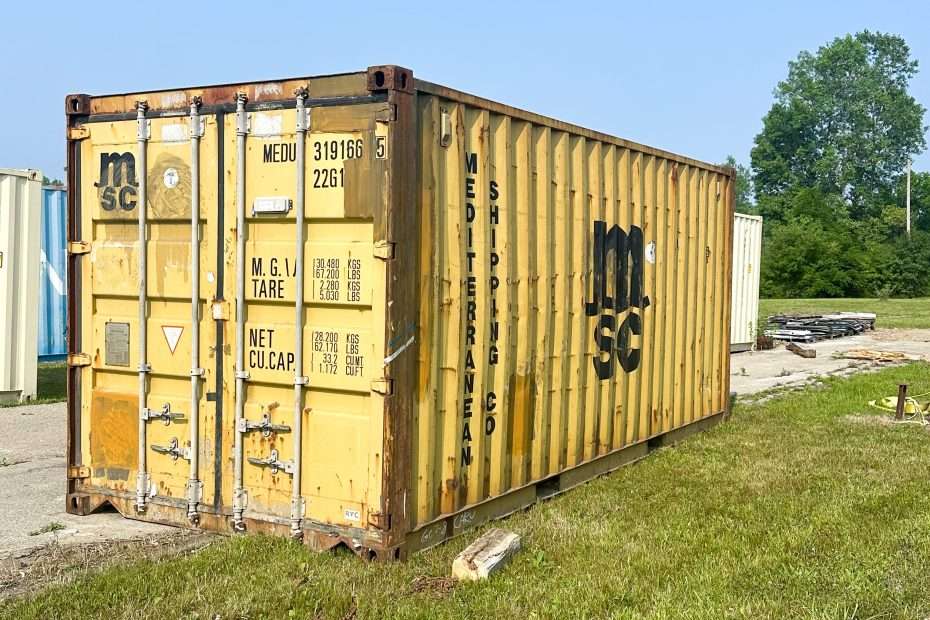
A container for construction site storage keeps tools, materials, safety equipment, and jobsite supplies close to the work: without leaving them exposed in trailers, trucks, or temporary sheds.
For Michigan contractors, the main questions are practical:
- Is the container allowed at the jobsite?
- Do you need a zoning or building permit?
- How far must it sit from property lines?
- Can a tilt-bed trailer access the site?
- What surface should support the container?
- Should you rent or buy?
The answers depend on the city or township, zoning district, project duration, and intended use. Use this guide as a planning checklist, then confirm local requirements before delivery.
Temporary vs. Permanent Placement
Temporary Construction Storage
A container used only during active construction is often treated as a temporary use or portable storage structure.
Typical requirements:
- Active building permit for the property
- Temporary-use or zoning permit
- Approved placement area
- Removal by a specified deadline
- No placement in public rights-of-way
- No obstruction of fire lanes, required parking, sidewalks, or access routes
Time limits vary by municipality. For example, Port Huron Charter Township allows temporary storage containers with a permit valid for no more than 90 days in a calendar year. Other Michigan communities use 30-day, 60-day, or project-completion deadlines.
Some ordinances require removal shortly after the Certificate of Occupancy or completion of construction.
ACTION: Ask the local building or zoning department:
- Is a container allowed during active construction?
- Is a temporary-use permit required?
- Does the container permit attach to the building permit?
- What is the maximum placement period?
- When must the container be removed?
Permanent or Long-Term Placement
A container kept after construction may be classified as an accessory structure, storage building, or permanent installation.
Additional requirements may include:
- Building permit
- Zoning approval
- Site plan review
- Foundation or anchoring requirements
- Additional setbacks
- Screening or fencing
- Restrictions on modifications, utilities, or use
A container used as a permanent office, workshop, retail space, or occupied structure may trigger additional building, electrical, plumbing, fire, and occupancy requirements.
Do not assume a temporary construction approval allows permanent use. The classification can change once the project is complete.

Commercial and Industrial Sites vs. Residential Sites
Commercial and Industrial Construction Sites
Commercial and industrial zoning districts are generally more accommodating to construction storage containers. However, approval is still local.
Possible requirements:
- Zoning or temporary-use permit
- Site plan review
- Building Department approval
- Fire Department review
- Setback compliance
- Separation between multiple containers
- No use in required parking or fire lanes
- No hazardous-material storage unless specifically approved
Port Huron Charter Township, for example, requires permits and review for containers in business or industrial districts. Its ordinance also addresses container spacing, setbacks, parking, fire lanes, modifications, utilities, and hazardous materials.
Planning standard: Keep the container outside required parking areas, emergency access routes, landscaped areas, and designated construction access lanes.
Residential Construction Sites
Residential placement is more variable and often more restrictive.
Local rules may:
- Allow a container only during active construction
- Limit the number of containers
- Restrict placement to a driveway, side yard, or rear yard
- Require minimum parcel sizes
- Prohibit permanent container storage
- Require screening from neighbors or the public road
- Limit the number of days on-site
Some Michigan communities prohibit shipping containers as accessory buildings in residential zones. Others permit them with specific setbacks and time limits.
REQUIRED CHECK: Confirm the site’s zoning district before ordering. A container that is acceptable at an industrial project may not be allowed at a residential renovation.
Setback and Placement Requirements
There is no single Michigan-wide setback distance for every shipping container. Requirements are established by the local municipality and zoning district.
Common placement rules include:
- Side and rear property-line setbacks
- Front-yard restrictions
- Minimum distance from principal buildings
- Minimum distance between containers
- No placement in public rights-of-way
- No obstruction of sidewalks or sight lines
- No placement in required parking or fire lanes
As one local example, Port Huron Charter Township requires containers to meet the setbacks of the applicable zoning district and maintain at least 10 feet between containers.
Before delivery, mark the exact drop location. Do not rely on moving the container later with a forklift or crane. Relocation can require additional equipment, fees, permits, and site repairs.
PLACEMENT CHECKLIST:
- Container fully on private property
- Required property-line setbacks measured
- Doors facing a usable access route
- Fire lanes and exits clear
- Required parking spaces preserved
- No sidewalk or public-right-of-way obstruction
- Container location staked before truck arrival
- Local approval documented
Delivery Logistics: Tilt-Bed Trailer Requirements
Shipping containers are typically delivered on a tilt-bed or similar specialized trailer. The truck does more than unload: it must safely position the container and pull out from underneath it.
Required Site Access
Check the entire route, not just the final drop point:
- Road width
- Gate width
- Driveway condition
- Turning radius
- Soft shoulders
- Low bridges
- Overhead wires
- Tree branches
- Building overhangs
- Temporary fencing
- Scaffolding
- Heavy equipment in the travel path
For a typical delivery, plan for approximately 110 feet of straight clearance from the back of the intended placement area so the driver can unload and slide the trailer out. Exact requirements vary based on the container size, truck, site conditions, and placement direction.
A 40ft container requires more planning than a 20ft container. A 40ft High-Cube: 40 HC: also adds height and may create additional clearance concerns near wires, branches, and structures.

Delivery-Day Requirements
Before the truck arrives:
- Remove vehicles, debris, equipment, and temporary barriers.
- Open gates and confirm the delivery route.
- Mark underground utilities and restricted areas.
- Keep workers clear of the unloading zone.
- Confirm the driver can reach the approved placement area.
- Verify the container will not land outside the permitted location.
- Maintain a safe path for future pickups.
If delivery requires temporary use of a public road, lane, sidewalk, or state right-of-way, additional local or MDOT approval may be required. MDOT provides information on oversize/overweight permits and right-of-way construction permits.
Site Preparation: Gravel, Leveling, and Drainage
A container can sit on compacted gravel, concrete, asphalt, or another firm surface. The priority: stable support, proper drainage, and level doors.
Recommended Base
For most construction sites:
- Compacted gravel pad
- Two or more parallel support lines
- Concrete blocks, railroad ties, or treated timbers under the corner castings
- Clear drainage path around the pad
- No standing water
- No loose mud or unstable fill
The container’s primary load points are the four corners. Support those points properly instead of placing the unit directly on uneven ground.
Leveling
An uneven container can cause:
- Doors that bind
- Door seals that fail
- Water intrusion
- Uneven floor loading
- Structural stress
- Difficulty using pallet jacks or carts
Use a level base and adjust with appropriate blocking. Recheck the container after heavy rain, thawing, or significant site activity.
Avoid placing the container where excavation, grading, or utility work is scheduled. A temporary location that must be moved twice adds cost and delays.
Security for Tools and Materials
A steel storage container is a strong jobsite security upgrade, but the lock and site controls matter.
Recommended setup:
- High-security puck lock
- Factory lockbox, when available
- Heavy-duty hasp where appropriate
- Motion lighting
- Camera coverage
- Limited access list
- Weekly inventory checks
- Clearly labeled tool zones
- No hazardous-material storage unless specifically approved
Standard containers are constructed from heavy-duty steel and commonly supplied in WWT: Wind and Water Tight: condition. They provide protection from rain, snow, and normal jobsite exposure.
For frequent access, organize the interior before loading:
- Tools near the doors
- Long materials along the side walls
- High-value equipment away from sight lines
- Shelving secured to prevent shifting
- Walkway maintained from the doors to the back
Do not block the doors, ventilation features, or required access areas.

Choose the Right Container Size
20ft Container
Best for:
- Smaller remodeling projects
- Tools and safety equipment
- Compact urban sites
- Limited-access jobsites
- Short-term residential construction
Approximate floor area: 160 square feet.
40ft Standard Container
Best for:
- Larger construction projects
- Lumber and building materials
- Multiple trade crews
- Equipment and inventory overflow
- Long-duration commercial work
Approximate floor area: 320 square feet.
40ft High-Cube Container: 40 HC
Best for:
- Tall materials
- Larger equipment
- Extra vertical clearance inside
- High-volume storage
- Long-term commercial or industrial projects
A 40 HC provides approximately one additional foot of interior height compared with a standard-height container. Confirm exterior clearance before delivery.
Review available container products or compare options such as 20ft WWT, 40ft WWT, and 40ft High-Cube WWT.
Rent vs. Buy for Construction Projects
Rent an On-Site Storage Container When:
- Project duration is uncertain
- Storage is needed for a few months
- The container will leave after completion
- Upfront capital needs to stay low
- You do not want resale responsibility
Review the on-site storage container rental process for rental details, delivery planning, and pickup coordination.
Buy a Container When:
- The project requires long-term storage
- You manage multiple jobsites
- The container will be reused
- You need permanent inventory capacity
- You want to modify the unit later
- Long-term rental costs approach the purchase price
Buying provides control over the container and future placement. Renting provides flexibility and simpler project closeout.
Constable Containers Delivery for Michigan Contractors
Constable Containers provides USED, WWT, One Trip, and IICL options in 20ft, 40ft, and 40 HC sizes.
Contractor advantages:
- Flat $500 delivery up to 90 miles
- Auto-calculated delivery pricing beyond the included range
- Instant ZIP code pricing online
- Sale and rental options
- Michigan delivery
- Fast scheduling
- Direct, local communication
- Family-business service: not a faceless national corporation
Use the instant quote options to enter your ZIP code and review available pricing. For complex sites, multiple units, tight access, or unusual placement requirements, CONTACT US before scheduling delivery.
Final Jobsite Checklist
- Confirm the city or township.
- Verify the zoning district.
- Ask whether a temporary-use, zoning, or building permit is required.
- Confirm setbacks and placement restrictions.
- Prepare a level gravel, asphalt, or concrete surface.
- Plan drainage and corner support.
- Clear at least 110 feet of straight delivery space.
- Check overhead and side clearance.
- Keep fire lanes, parking, sidewalks, and exits clear.
- Choose 20ft, 40ft, or 40 HC capacity.
- Decide whether to rent or buy.
- Get instant ZIP code pricing.
- Schedule delivery only after the site is ready.
NEED A CONTAINER FOR YOUR CONSTRUCTION SITE? GET AN INSTANT QUOTE TODAY.
Local rules control container placement. Confirm permit and zoning requirements with the municipality before delivery. For Michigan delivery, pricing, size selection, and jobsite access questions, contact Constable Containers.
