
Small-business storage problems usually appear before the need for a larger warehouse.
Inventory spreads into work areas. Employees spend more time searching. Orders slow down. Growth opportunities get postponed because there is nowhere to put additional stock.
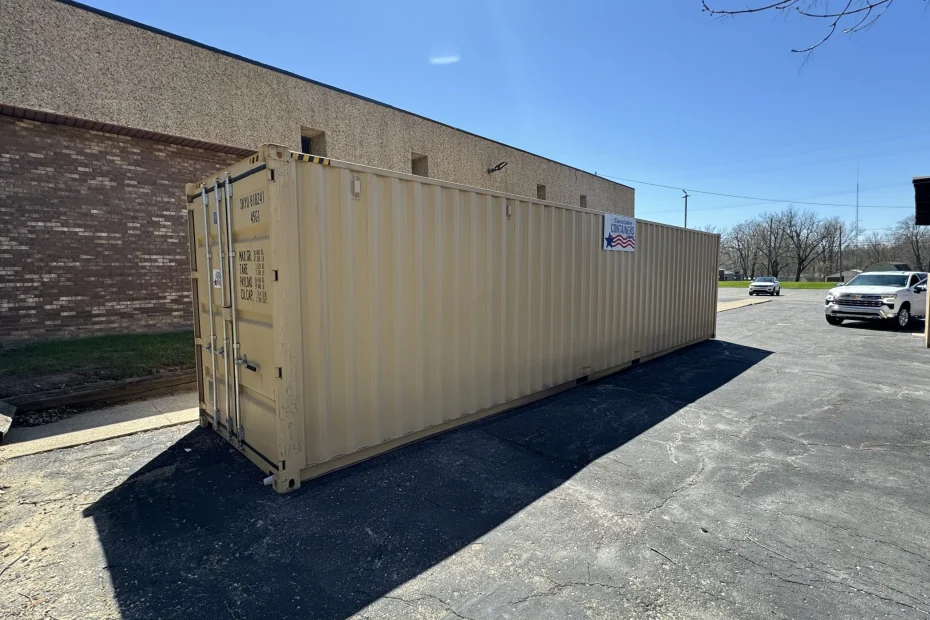
For many Michigan businesses, an on-site shipping container adds the required capacity without committing to a large commercial lease.
Constable Containers sells and leases 20FT, 40FT, and 40FT HIGH-CUBE containers throughout Michigan. Use the guide below to identify the warning signs, compare storage costs, and select the right container size.
Sign #1: Inventory Is Spilling Into Walkways And Workspaces
Common indicators:
- Products stored on shop floors
- Boxes stacked under tarps
- Seasonal inventory left in trucks or trailers
- Parts stored around workbenches
- Customer or employee walkways used as temporary storage
- Overstock mixed with active inventory
- Outdoor items exposed to rain, snow, and temperature swings
This creates more than a housekeeping issue. Blocked walkways increase safety risks. Outdoor storage can damage packaging and products. Stock placed wherever space is available becomes harder to count, label, and protect.
An on-site container creates a dedicated overflow zone next to the business. Use it for:
- Overstock and bulk inventory
- Seasonal products
- Packaging materials
- Tools and equipment
- Archived records
- Promotional displays
- Slow-moving SKUs
- Incoming inventory awaiting processing
A standard 20FT container provides approximately 160 SQ FT of floor space and can hold roughly 10 standard pallets in a single layer, depending on pallet dimensions and loading layout.

Sign #2: Shuffling Inventory Is Slowing Fulfillment
Storage capacity affects order speed directly.
If employees must move three pallets to reach one SKU, the business is paying for unnecessary labor. If stock locations change every week, inventory records become less reliable. If products are stored in multiple trucks, rooms, or off-site units, mis-picks and delayed shipments become more likely.
Warning signs:
- Staff reorganizing inventory before pulling orders
- Frequent SKU location changes
- Mis-picks and incorrect quantities
- Longer order turnaround times
- Employees asking where products are stored
- Picking routes that cross active work areas
- Inventory counts that do not match system records
- Orders delayed because stock is in another location
A container can function as an organized secondary warehouse directly on the property. Establish fixed zones for:
- Fast-Moving SKUs: closest to the doors
- Bulk Inventory, palletized and labeled
- Seasonal Stock: back rows or upper racking
- Returns and Damaged Goods: separate marked area
- Packaging Supplies: accessible without moving product
For businesses using forklifts or pallet jacks, door orientation matters. Position container doors toward the loading area and maintain a clear approach. A 40FT container typically requires approximately 100+ feet of straight-line delivery clearance, while a 20FT delivery generally requires approximately 60 feet, depending on equipment and site conditions.
Sign #3: Your Current Storage Setup Is Limiting Growth
Storage problems become expensive when they affect revenue.
A business may turn down a bulk order because it cannot safely receive or stage the inventory. A new product line may be delayed because existing products already occupy every available area. Multiple small storage locations may keep operations running, but travel time and repeated handling reduce margins.
Growth-related warning signs:
- Declining bulk-order capacity
- Delayed product launches
- Inventory split between multiple locations
- Extra mileage for staff retrieving stock
- Monthly storage bills from several facilities
- Trucks or trailers used as permanent storage
- Customers waiting while inventory is located
- No room for new equipment or packaging stations
An on-site container does not replace a full warehouse when a business needs docks, offices, climate control, or thousands of square feet. It can, however, provide an efficient intermediate step between crowded operations and a major commercial lease.
Container Size Options For Small Businesses
| Container | Approx. Floor Space | Planning Capacity | Best Use |
|---|---|---|---|
| 20FT STANDARD | ~160 SQ FT | ~10 pallets | Small-business overflow, tools, seasonal inventory |
| 40FT STANDARD | ~320 SQ FT | 20+ pallets | Bulk inventory, equipment, wholesale stock |
| 40FT HIGH-CUBE (HC) | ~320 SQ FT | 20+ floor pallets; more with racking | Tall products, pallet racking, stacked storage |
A 40FT HC provides the same basic footprint as a standard 40FT container but adds approximately one foot of exterior height. The additional interior clearance makes it better suited for:
- Pallet racking
- Taller shelving
- Double-stacking compatible products
- Long or bulky inventory
- More vertical storage
Do not assume every product can be stacked. Confirm product weight, packaging strength, forklift access, and rack specifications before loading.

What Does The Container Fix Cost?
Actual pricing depends on inventory, condition, location, rental duration, and delivery requirements. Use these figures as planning ranges, not a final quote.
On-Site Container Rental
Typical Michigan and Midwest planning ranges:
- 20FT rental: approximately $100–$175 per month
- 40FT rental: approximately $150–$250 per month
- Delivery and pickup: quoted separately or included according to the rental agreement
Renting is usually the better starting point when:
- Storage needs may change
- The project lasts several months
- You want lower upfront costs
- You need a temporary inventory buffer
- You are testing on-site storage before buying
Search for storage container rental Michigan and confirm monthly rates, minimum terms, delivery charges, pickup charges, and responsibility for site preparation.
Buying A Container
Buying requires more upfront capital but can reduce the long-term cost of storage.
Used container pricing varies by size, condition, grade, and current availability. A USED WWT unit typically costs less than a ONE-TRIP container. A higher-grade IICL unit may cost more but can offer improved appearance and structural condition.
Buying can make sense when:
- Storage is needed for 6+ months
- Inventory volume is stable
- The business controls suitable property
- You want 24/7 access without traveling to a storage facility
- You want to avoid indefinite monthly rent
- The container may later be used for equipment, staging, or a new location
The basic ownership calculation:
Container purchase price + delivery + site preparation ÷ expected months of use = estimated monthly ownership cost
At six months or longer, ownership or controlled on-site storage can reach break-even against repeated storage rent: depending on the purchase price, delivery, rental rate, and site costs. For multi-year use, buying generally wins because the business retains an asset instead of continuing monthly payments.
Container Vs. Warehouse Lease Vs. Self-Storage
| Option | Typical Fit | Cost Structure | Main Limitation |
|---|---|---|---|
| 20FT/40FT Container Rental | 160–320 SQ FT of overflow | Monthly rent plus delivery terms | Requires usable on-site space |
| Container Purchase | Long-term inventory or equipment | Upfront purchase plus delivery | Requires capital, zoning approval, and site prep |
| Self-Storage | Flexible short-term inventory storage | Approximately $110–$180/month for many 10×20 units; market varies | Travel required; access rules vary |
| Warehouse Lease | Larger operations needing docks and work areas | Base rent plus NNN charges, utilities, and maintenance | Often 1,000–2,500 SQ FT minimums or more; longer commitment |
A warehouse lease may include triple-net (NNN) charges for property taxes, insurance, and common-area maintenance. Even if the advertised rate appears reasonable, the total monthly obligation can become significant once utilities, snow removal, insurance, and operating costs are added.
For a few hundred square feet of storage, a warehouse lease is often oversized. For several thousand square feet plus loading docks and active fulfillment space, a warehouse may be the correct next step.
Site Checklist Before Ordering
Confirm these items before scheduling delivery:
- Level, compacted ground: gravel, asphalt, concrete, or firm dry soil
- Drainage, no standing water or soft areas
- Truck clearance, approximately 60 feet for many 20FT deliveries; 100+ feet for many 40FT deliveries
- Overhead clearance: check wires, trees, rooflines, and signs
- Door orientation, face doors toward the loading and access area
- Forklift access, verify turning space and approach width
- Zoning: check city, township, county, and commercial-property requirements
- Security: plan for a lock, lighting, cameras, or controlled access
- Container support: use blocks or appropriate supports to promote drainage and level doors
Review same-day vs. scheduled container delivery in Michigan before ordering.
Why Choose Constable Containers?
Constable Containers provides:
- 20FT, 40FT, and 40FT HC containers
- SALE and LEASE options
- USED, WWT, IICL, and ONE-TRIP availability, subject to inventory
- $500 FLAT DELIVERY up to 90 miles
- Instant pricing by entering your ZIP code
- Same-day delivery when ordered by 10:00 AM, subject to availability
- Scheduled delivery in 1–3 business days
- An owned delivery fleet with NO BROKERS
- Family-business service and direct communication
- Michigan-wide delivery support
SAVE $100 ON ALL CONTAINER PURCHASES, LIMITED-TIME PROMO.
GET AN INSTANT QUOTE using your ZIP code, or CONTACT CONSTABLE CONTAINERS for help selecting the correct size.
Frequently Asked Questions
Is A Shipping Container Good For Business Inventory?
Yes, for suitable products. Containers provide secure, weather-resistant storage for inventory, equipment, tools, packaging, and seasonal stock. Use pallets, shelving, ventilation, and moisture-control practices appropriate for the goods stored.
Should I Rent Or Buy A Container?
Rent when the need is temporary or uncertain. Buy when storage will be used for six months or longer, the site is available, and long-term ownership provides better economics.
How Much Space Does A 40FT Container Provide?
A standard 40FT container provides approximately 320 SQ FT of floor space and can hold approximately 20 or more standard pallets in a single layer, depending on layout. A 40FT HC adds vertical clearance for racking and stacking.
Can A Forklift Load A Container?
Yes, but the site must provide enough approach space, turning room, ground strength, and door clearance. Confirm your forklift dimensions and loading plan before delivery.
Do I Need Zoning Approval?
Requirements vary by city, township, property type, and intended use. Check local zoning rules before ordering. Commercial and industrial properties may have different requirements from residential properties.
{“@type”:”Article”,”about”:[“rent shipping containers Michigan”,”storage container rental Michigan”,”small business inventory storage”,”on-site shipping container storage”],”image”:[“https://cdn.marblism.com/gSSJUmopln3.webp”,”https://cdn.marblism.com/gdnF32QvDZP.webp”,”https://cdn.marblism.com/JudWFKhbHiE.jpg”],”author”:{“url”:”https://constablecontainers.com/”,”name”:”Constable Containers”,”@type”:”Organization”},”@context”:”https://schema.org”,”headline”:”3 Signs Your Michigan Business Has Outgrown Its Storage Setup (and What a Container Fix Costs)”,”publisher”:{“url”:”https://constablecontainers.com/”,”name”:”Constable Containers”,”@type”:”Organization”},”description”:”A practical guide for Michigan small businesses covering three signs of inadequate storage, container size options, on-site rental versus warehouse costs, site requirements, and container delivery.”,”mainEntityOfPage”:{“@id”:”https://constablecontainers.com/”,”@type”:”WebPage”}}