
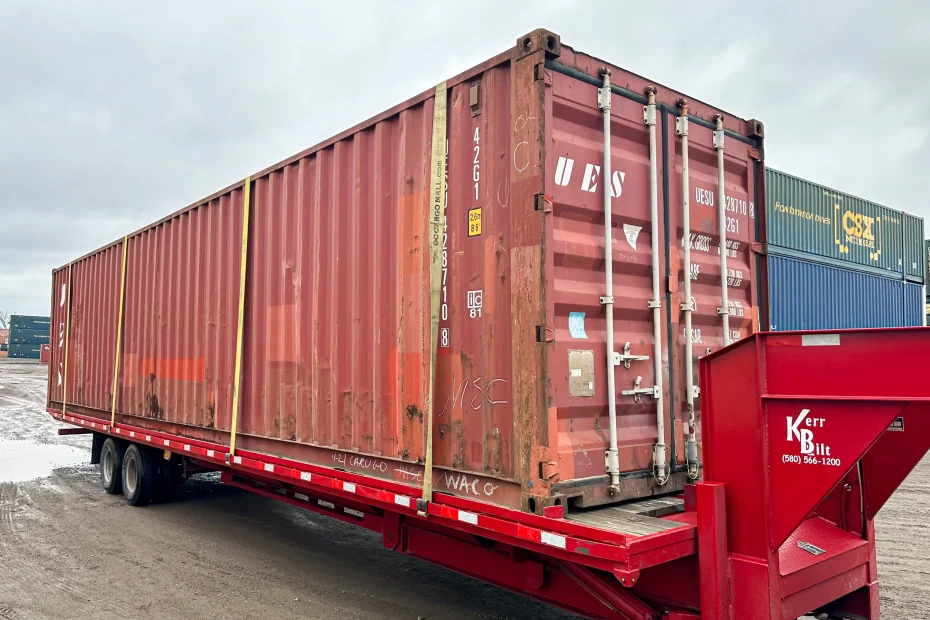
Already own a shipping container and need it moved? Your price depends on more than miles. Container size, loaded weight, truck type, road restrictions, and site access at both ends can all change the quote.
For 2026 planning, domestic container transport commonly runs $2–$8 per mile. Equipment-specific estimates include $4.50–$6.50 per mile for tilt-bed or Landoll transport and $3.50–$5.00 per mile for flatbed transport, typically with offloading arranged separately. Treat these as budgeting ranges, not guaranteed rates. Carriers may use minimum charges, round-trip mileage, or separate handling and access fees. Get an itemized quote using your exact route and site details.
2026 Price Ranges At A Glance
| Cost item | Planning range |
|---|---|
| Domestic transport | $2–$8 per mile |
| Tilt-bed / Landoll | $4.50–$6.50 per mile |
| Flatbed | $3.50–$5.00 per mile, offloading not included |
| Sideloader or crane assistance | $200–$800+ per move |
| Standalone crane | $1,500–$4,000 per route end |
| Loaded move compared with empty | Often 20%–40% more |
Rates vary by carrier, route, container weight, scheduling, and required equipment. Some public 2026 transport estimates also show distance-based flat rates, rather than a simple per-mile calculation. Use the ranges above to frame conversations, not to assume your final total. For a broad market reference, see this 2026 container transport cost overview.
What Determines The Cost?
Size and height: A 20ft container is shorter and usually easier to handle than a 40ft unit. A standard 40ft and a 40ft High-Cube (HC) have the same approximate footprint, but the HC is about a foot taller. That extra height can affect overhead clearance and transport planning. Container tare weights vary by make and age, so give the mover the container’s actual specifications when available.
Loaded or empty: Loaded containers can cost 20%–40% more due to weight charges, route limits, and added handling requirements. The mover may need an accurate cargo weight before confirming equipment or legal road access.
Distance and route: Mileage matters, but so do deadhead miles, highway access, tolls, road restrictions, and whether the truck can reach each site directly. Rural access roads or difficult turns may require a different plan.
Equipment and site access: A tilt-bed may be cost-effective where there’s enough straight approach and room to slide the container off. A sideloader or crane may raise the equipment cost but solve access problems that would otherwise prevent the move.
Example: What Might A 100-Mile Move Cost?
At the listed planning rates, 100 miles of tilt-bed transport works out to roughly $450–$650 for the line haul. A flatbed at $3.50–$5.00 per mile works out to about $350–$500, but you’ll need to arrange and pay for offloading separately. These calculations are not final quotes. Loaded weight, equipment, scheduling, mileage rules, and site conditions can change the total.
Ask whether the quote includes both route mileage and placement, and whether it covers both ends of the move. A low per-mile rate can be misleading if it excludes loading, offloading, or a return trip.

Should You Move It Loaded Or Empty?
Empty it first when:
- The contents are heavy, fragile, loose, or difficult to secure.
- You don’t know the loaded weight, or the mover needs a weight estimate to confirm the route.
- Items could shift and damage the container, doors, or contents during loading and transport.
- You want to reduce stress on the door seals and locking hardware.
- Your insurer or mover requires the container to be empty.
Moving it loaded may make sense when:
- The load is non-fragile stock or furniture that is firmly strapped and braced.
- Emptying and reloading would cost more than the carrier’s loaded-move premium.
- The mover confirms the estimated gross weight and will transport a loaded unit.
- Your contents are covered during transit and the container doors can be securely closed.
Tell the mover what’s inside, how it’s secured, and the estimated total weight. Don’t assume cargo insurance automatically covers your contents. Confirm coverage, exclusions, and responsibility for loading in writing.
Choosing The Right Equipment
Tilt-bed / Landoll: The truck positions the trailer and tilts or slides the container into place. Often suitable when there’s a firm, level drop area and a clear approach. The carrier must confirm the available space and placement method.
Flatbed: May offer a lower transport rate, but the container needs separate loading and offloading equipment. Confirm who is arranging that equipment, who is paying, and whether its arrival is coordinated with the truck.
Sideloader: Lifts the container from the side and can load, transport, and place it without a separate lifting vehicle. It can be a good option where a straight tilt-bed approach is impractical or placement space is limited. Check the quoted premium and required working room.
Crane: Consider a crane when the container must go over a fence, building, or other obstacle, or into a tight backyard. A standalone crane may cost $1,500–$4,000 per route end, depending on the job. Confirm mobilization, operator, rigging, setup, and any site-control charges.

Check Both Sites Before Booking
The pickup and destination each need to work for the truck and selected equipment. As a planning guideline, allow roughly 100 feet of straight approach and 14 feet of vertical clearance for a loaded delivery truck. Actual needs vary by trailer, container length, and placement method. Ask the carrier to confirm its requirements before dispatch.
Check for:
- Firm, level ground at pickup and drop-off
- Clear truck approach, turning space, and exit route
- Overhead wires, tree branches, roofs, and other height restrictions
- Gate width and the space needed to position lifting equipment
- Septic fields, drain lines, and other areas that may not support heavy equipment
- Soft spring ground, steep grades, and narrow driveways
Send recent photos of both sites. Include the approach, the intended container position, the gate, and nearby overhead obstacles. A mover can’t reliably assess access from an address alone.
Michigan Frost Laws And Winter Moves
Michigan’s seasonal weight restrictions can affect the route and timing of heavy truck moves during the spring thaw. For 2026, MDOT lifted the remaining statewide spring weight restrictions on May 15, but county road commissions and local road authorities may set their own restrictions. Check both state and local road conditions for your specific route and moving date. See MDOT’s 2026 frost-law announcement.
In winter, clear the approach and destination before the truck arrives. Plowed snowbanks can block a gate or prevent the driver from placing the container where planned. Build in buffer days for snow, ice, and changing site conditions.

Verify Destination Permits Before Scheduling
Container rules are local. City, township, or village ordinances may set requirements for parcel size, rear-yard placement, setbacks, screening, and how long a container may remain on-site. HOA rules and deed restrictions may be stricter.
Michigan’s building-code exemption for certain detached accessory structures of 200 square feet or less does not automatically waive zoning rules or other local requirements. Municipalities may also classify containers differently from ordinary accessory structures. For example, Pinckney’s local ordinance specifies conditions for storage containers. Check with the destination municipality’s zoning and building departments before you book the truck.
Get An Accurate Quote: 5 Steps
- Provide both full addresses. Include ZIP codes and note any restrictions on the route or access road.
- Identify the container. Give the length, standard or HC height, and tare weight if known.
- State whether it’s loaded. Share the estimated cargo weight and describe how contents are braced.
- Send photos of both sites. Include gate widths, approach, placement area, overhead wires, and obstacles.
- Request an itemized written quote. Confirm mileage, equipment, loading and offloading, extra handling, timing, and insurance responsibility.
Be cautious of movers who quote without asking for container details or site information, don’t discuss seasonal road restrictions, or insist on cash-only payment without paperwork. Get the agreed price and scope in writing.
When A Second Container May Cost Less
If you expect to move the same container several times over the next few years, repeated hauling can add up. Compare the total relocation costs with purchasing a second unit for the new site. If your storage needs have changed, upgrading may also be more practical than paying for another move.
If you’re comparing options, explore Constable Containers’ 20ft, 40ft, and 40ft HC containers or request an instant quote. Constable Containers is a family-owned Michigan business with an in-house delivery fleet. For eligible delivery or repositioning, delivery is $500 up to 90 miles, with distance calculated beyond that. Share your ZIP code and site details to confirm the exact quote. A $100-off limited-time offer is available on container purchases. Same-day delivery may be available for orders placed by 10 AM; otherwise, scheduling is typically 1–3 business days, subject to route and availability.
Need a container moving service for a unit you already own? Contact the team with both addresses, container size, loaded status, and site photos. Comparing a shipping container for sale near me or portable storage containers in Michigan? Get a ZIP-based quote before you commit to another haul.