
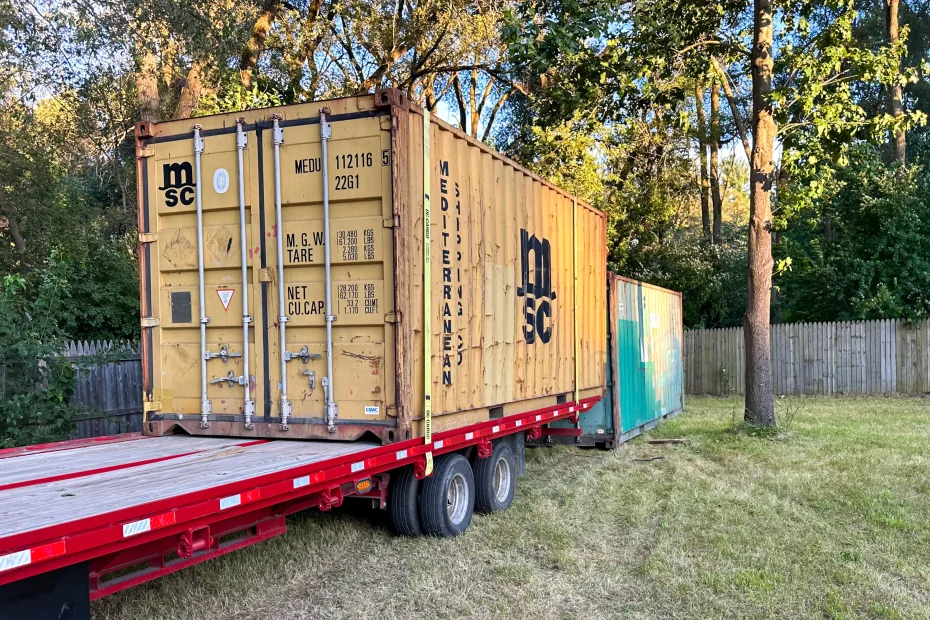
The most common delivery-day question from Michigan container buyers:
“What do I need to prepare before the container arrives?”
The answer depends on how long the container will stay, how you plan to use it, your soil and grading, and whether Michigan’s freeze-thaw cycle can move the foundation.
For basic storage, a properly built gravel pad is usually the most practical shipping container foundation. For permanent placement, heavy modifications, occupancy, or conversion projects, use engineered concrete piers, helical piers, or a frost wall extending below the local frost depth.
Michigan Frost Line: Why It Controls the Foundation
Michigan ground freezes, expands, and moves seasonally. In much of the state, design frost depth is approximately 42 inches. Some northern Michigan and Upper Peninsula locations require deeper protection.
Verify the official requirement with your local building department. The Michigan Residential Code foundation provisions generally require permanent supports to be protected from frost, commonly by extending below the frost line.
Freeze-thaw movement creates several container problems:
- Seasonal heave under one corner
- Container frame twisting
- Doors that bind or will not latch
- Gasket compression and water leaks
- Standing water beneath the floor
- Increased rust at corner castings and bottom rails
- Uneven loading on the container frame
A container is structurally strong, but it still needs four stable bearing points. Poor site preparation can turn a straightforward delivery into a re-leveling callback.
Option 1: Compacted ¾-Inch Crushed Stone Pad
Best For
- Temporary or seasonal storage
- Unmodified USED or WWT containers
- Residential storage during a move or remodel
- Jobsite tools and materials
- Containers that may be relocated later
- Sites with firm, reasonably well-drained soil
Recommended Pad Specifications
- 4–8 inches of compacted ¾-inch crushed stone
- Angular aggregate with fines that lock together
- Pad level within approximately ½–1 inch
- Pad extending beyond the container bearing points
- Positive drainage away from the container
- Timber or solid concrete block supports at the corners when additional elevation or leveling is needed
Do not use pea gravel as the primary pad material. Pea gravel is rounded, rolls under load, and does not lock together. It can shift when the container is set down or when the loaded unit experiences seasonal movement.
Use ¾-inch crushed stone, often sold as ¾-inch minus or a similar dense-grade aggregate. Strip vegetation and organic topsoil first. Compact the native subgrade, install geotextile fabric if the soil is soft or silty, then place and compact the stone in lifts.
The finished pad should be firm enough that a boot heel does not sink into it. A plate compactor is strongly recommended.
Drainage and Slope-Away
Water is the enemy of a long-lasting container foundation. Grade the surrounding ground so water moves away from the pad, not toward it. Where site conditions permit, a common residential drainage benchmark is a fall of approximately 6 inches within the first 10 feet.
Also confirm:
- No low spot directly beneath the doors
- No roof runoff discharging beside a corner
- No grass, mulch, or soil contacting the bottom rail
- No snowmelt path toward the container
- Adequate space for snow removal and door access
A gravel pad does not eliminate frost movement. It improves drainage and distributes the load, but the pad can still move with the underlying soil. Plan to re-level a storage container if the site shifts over time.

Corner Supports: Timbers and Concrete Blocks
A container’s primary load transfers through its corner castings. On a gravel pad, place supports directly under the corners.
Common support choices:
- Pressure-treated timbers
- Railroad ties
- Solid concrete blocks
- Precast pads
- Steel container support plates
Use sound, level, load-rated materials. Avoid loose stacks of small blocks, deteriorated lumber, landscaping bricks, or improvised shims.
For a standard storage placement, corner supports can help:
- Keep the bottom rail above wet ground
- Improve air circulation
- Correct minor grade differences
- Improve door operation
- Reduce contact with snow and standing water
Do not use corner blocks as a substitute for a deep foundation when the container will become a dwelling, office, occupied workshop, or heavily modified structure.
Option 2: Concrete Piers, Helical Piers, or Frost Walls
Best For
- Permanent storage placement
- Container homes, offices, and workshops
- Pop-up shops with utilities
- Doors, windows, wall openings, and structural modifications
- Stacked containers
- Heavy point loads or concentrated equipment
- Soft clay, fill, expansive, or frost-sensitive soils
- Locations where re-leveling is unacceptable
Permanent supports should generally extend to or below the local frost depth. For a site with a 42–48-inch frost requirement, the foundation designer may specify pier bottoms at approximately 48–60 inches, depending on footing geometry, local code, soil, loading, and required embedment.
Concrete Piers
Typical layouts use piers beneath the container corners, with additional supports at mid-span or other load points when required.
A proper design may include:
- Sonotube or formed concrete piers
- Reinforced concrete
- Footings sized for soil bearing capacity
- Steel brackets or plates at the top
- Container anchorage for wind and lateral loads
- Inspection and permitting as required
Helical Piers
Helical piers are steel foundation elements screwed into the ground to reach competent soil below the frost zone. They can be useful when:
- Winter excavation is difficult
- Concrete curing conditions are poor
- Access is limited
- The site has variable soil
- The project requires engineered permanent support
A qualified installer or engineer should size the system. Helical piers are not a universal DIY replacement for concrete.
Frost Walls
A continuous frost wall or strip footing may be appropriate for a permanent conversion project, especially where the container will be attached to another structure or supported as a building. This is a design-and-permit project, not standard storage site preparation.
Gravel Pad vs Concrete Foundation: Decision Framework
Use this checklist before scheduling delivery.
| Project Condition | Recommended Foundation |
|---|---|
| Seasonal storage; unmodified container | 4–8-inch compacted crushed stone pad |
| Short-term moving or remodeling storage | Gravel pad with corner supports |
| Long-term storage; stable doors required | Gravel pad on good soil, or piers if movement is unacceptable |
| Clay, fill, wet, or frost-sensitive soil | Concrete or helical piers; obtain site advice |
| 20ft or 40ft storage container with no modifications | Gravel pad usually appropriate |
| Stacked containers or heavy concentrated loads | Engineered piers, piles, or frost wall |
| Windows, personnel doors, insulation, utilities | Concrete or helical foundation; verify code |
| Office, workshop, studio, or habitable conversion | Engineered frost-protected foundation |
| Snow-clearing route beside container | Elevated, well-drained support system |
| Permanent structure near a slope or drainage issue | Local review and possible engineering required |
Budget matters, but the least expensive foundation is not always the least expensive project. A low-cost gravel pad that needs repeated correction can cost more than a correctly designed pier system.
Foundation Cost Comparison
Typical Michigan project ranges. Actual cost depends on access, excavation, soil, size, engineering, permits, and contractor availability.
| Foundation Type | Typical Cost Range | Installation Profile |
|---|---|---|
| DIY compacted gravel pad | $300–$1,200 | Materials, equipment rental, and site access |
| Contractor-installed gravel pad | $800–$2,500 | Excavation, fabric, aggregate, and compaction |
| Concrete corner piers | $2,500–$8,000 | Excavation, forms, reinforcement, concrete, brackets |
| Helical piers | $4,000–$12,000+ | Engineered system; difficult soil or limited access |
| Frost wall or continuous footing | $8,000–$20,000+ | Permanent structure; design, excavation, concrete, drainage |
These are foundation estimates only. Container price, delivery, permits, electrical work, insulation, and modifications are separate.
Site-Prep Mistakes That Cause Callbacks
Avoid these delivery-day problems:
-
Container placed directly on grass or soil
Results: settlement, standing water, bottom-rail corrosion. -
Pea gravel used as the pad
Results: shifting supports and poor compaction. -
Pad out of level
Results: binding doors, uneven loading, gasket compression. -
Uncompacted fill beneath the pad
Results: settlement after the container is loaded. -
Organic topsoil left in place
Results: decomposition, soft spots, and uneven bearing. -
Drainage directed toward the container
Results: ice buildup, wet flooring, and rust. -
Blocks not aligned with corner castings
Results: point loading in the wrong location. -
No snow-clearing access
Results: blocked doors and difficult winter maintenance. -
Delivery route prepared after the ground freezes
Results: frozen soil, inaccessible equipment, and delays. -
Conversion planned after the foundation is installed
Results: insufficient supports, unplanned reinforcement, and permit issues.
Schedule Site Work Before Michigan Freezes
Ground preparation is easiest before winter. Frozen soil is difficult to excavate, compact, and grade. Concrete work also requires suitable temperatures and curing protection.
For a fall delivery:
- Confirm the container size and placement orientation.
- Check zoning, HOA, and local permit requirements.
- Confirm official frost depth and soil concerns.
- Complete excavation, grading, and compaction before freeze-up.
- Keep the delivery route firm and clear of snow, mud, branches, and low wires.
- Leave access for future snow removal and door operation.

Choose Your Michigan Container and Prepare for Delivery
Constable Containers offers USED, WWT, One Trip, and IICL options in:
Buy or lease throughout Michigan. Delivery is a flat $500 up to 90 miles, with delivery pricing auto-calculated beyond that distance. We operate our own in-house delivery fleet, no brokers.
Order by 10 AM for same-day delivery when inventory and route availability allow. Otherwise, delivery is typically scheduled within 1–3 business days.
$100 OFF ALL CONTAINER PURCHASES, LIMITED TIME ONLY.
Get an Instant Quote
Use the instant quote page and enter:
- ZIP Code*
- Container Size*: 20ft, 40ft, or 40ft HC
- Sale or Lease*
- Placement Address*
- Site Access Details*
For a basic storage unit, start with a compacted ¾-inch crushed stone pad. For permanent, occupied, stacked, or modified projects, contact your local building department and a qualified foundation professional before ordering.