
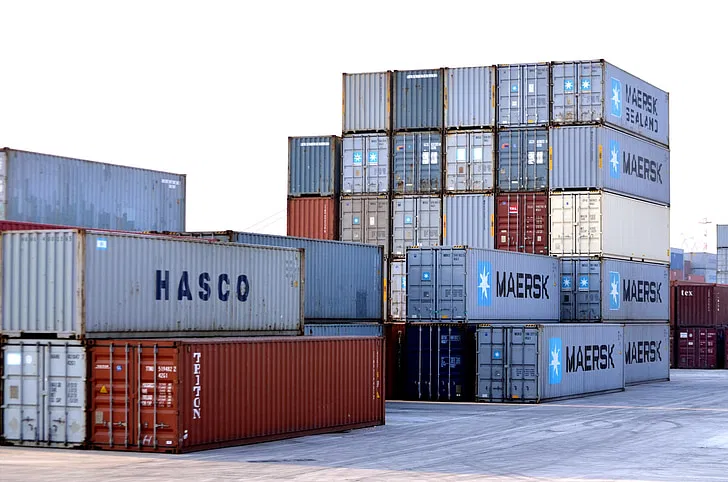
Yes. Shipping containers are designed for vertical stacking through their reinforced corner castings and corner posts. On private property, however, the safe limit depends on more than the container’s steel construction.
Ground conditions, container alignment, twist locks, wind exposure, snow loads, intended use, and local zoning all matter.
For most Michigan storage applications:
- Loaded containers: Typically 2 high; 3 high only with proper site preparation and professional review
- Empty containers: More than 3 high may be possible in controlled commercial yards with engineered foundations and handling equipment
- Residential properties: Often limited by zoning, setbacks, height rules, HOA restrictions, and permit requirements
- Occupied or modified structures: Engineering and building permits generally required
How Shipping Container Corner Castings Carry Weight
Shipping containers do not carry stacking loads evenly across the roof, walls, or floor. The primary vertical load path runs through:
- Four vertical corner posts
- Eight corner castings
- Top castings of the lower container
- Bottom castings of the upper container
When stacked correctly, the upper container’s bottom corner castings sit directly on the lower container’s top corner castings. This transfers the weight down through the corner posts and into the foundation.
The corrugated side panels and roof are not the primary stacking supports. Never assume that a flat roof or side wall can safely support another container without proper structural framing.
Alignment Requirements
- Corner castings directly above corner castings
- No visible offset
- No damaged or bent corner posts
- No cracked welds
- No severe corrosion around castings or bottom rails
- No soft, uneven, or shifting foundation
A container may be WWT: Wind and Water Tight: and still be unsuitable for stacking if its corner posts or castings are damaged. Inspect the structural corners before placing another unit above it.
20-Ft on 40-Ft vs. 40-Ft on 40-Ft
Container size and configuration affect how the load reaches the ground.
40-Ft on 40-Ft
A 40-ft container stacked on another 40-ft container is the most straightforward configuration.
- Same length
- Corner castings align directly
- Continuous support at all four corners
- Easier to secure with standard twist locks
- Common for commercial storage, construction sites, and industrial yards
Both containers should be structurally sound and positioned squarely. The bottom 40-ft container carries its own weight plus the weight of the upper unit and its contents.
Review 40-ft Standard USED WWT Containers and 40-ft High-Cube USED WWT Containers for available product categories.
20-Ft on 40-Ft
A single 20-ft container does not automatically create a direct corner-to-corner match when placed on top of a 40-ft container.
Potential issues:
- The 20-ft footprint covers only part of the 40-ft container
- Corner posts may not align with the lower container’s corner castings
- Offset loading can place excessive stress on the lower unit
- Wind resistance changes when the stack becomes taller and narrower
- Standard twist locks may not connect the units as intended
Two 20-ft containers positioned end-to-end over a 40-ft footprint may be possible in a purpose-designed arrangement, but do not assume the center connection is supported simply because the lengths match. Intermediate support beams, stacking frames, or engineered hardware may be required.
Do not place one 20-ft container centered on a 40-ft container without a structural plan.
For simple two-level storage, 40-ft-on-40-ft stacking is generally easier to plan. If you need compact units, review 20-ft USED WWT Containers and discuss the intended configuration before ordering.
How Many Shipping Containers Can Be Safely Stacked?
The theoretical stacking capacity of an ISO container is much higher than the practical limit for a Michigan property. Containers are stacked several levels high in ports and marine terminals because those locations use engineered pavement, cranes, twist locks, lashing systems, and controlled operating procedures.
Private properties are different.
Loaded Containers
Typical land-based guidance:
- One high: Simplest and most common
- Two high: Practical for many commercial and construction applications
- Three high: Possible with engineered foundations, professional lifting equipment, securing hardware, and site-specific review
- More than three high: Not a standard private-property configuration; requires professional structural and zoning review
The heavier the contents, the greater the demands on the lower container and foundation. Distribute stored materials carefully. Avoid placing extremely heavy equipment or dense materials in one concentrated area unless the container and support system are rated for it.
Empty Containers
Empty containers may be stacked higher in commercial yards because they create less vertical load. Even empty units, however, have substantial wind exposure.
A taller empty stack can become unstable when:
- Located in an open field
- Exposed to prevailing winds
- Not connected with twist locks
- Placed on soft or frozen ground
- Positioned near a slope or drainage area
MORE UNITS DOES NOT MEAN MORE SAFE STORAGE WITHOUT PROPER SITE DESIGN.

Foundation Requirements for Multi-Level Stacks
The foundation is one of the most important parts of a stacked-container project. The load concentrates at the four corner posts rather than spreading evenly across the entire footprint.
Level Ground
Start with a stable, level site.
- Remove topsoil, vegetation, and organic material
- Grade the area
- Compact the subgrade
- Correct drainage issues
- Keep the container clear of standing water
- Confirm that the truck and placement area can support delivery equipment
An unlevel base can cause door problems in a single container. In a multi-level stack, it can also create uneven loading and increased overturning risk.
Compacted Gravel Pad
A properly prepared gravel pad is often suitable for basic storage applications.
Recommended characteristics:
- Crushed, compactable aggregate
- Adequate depth for local soil conditions
- Compaction before delivery
- Drainage away from the container
- Separate support points beneath each corner
The exact pad design depends on soil type, container weight, stack height, and local frost conditions. Loose stone placed over soft soil is not an engineered foundation.
Concrete Piers
Concrete piers provide concentrated support under the corner posts and help keep the container above wet ground.
For permanent or multi-level installations:
- Piers may need to extend below the local frost depth
- Reinforcement and dimensions should match the design loads
- Anchor brackets may be required
- A structural engineer may need to review the plan
Michigan’s freeze-thaw cycles can cause frost heave and differential settlement. These movements can shift the lower container, misalign the stack, and damage doors or structural connections.

Twist Locks, Anchoring, and Wind Safety
Containers do not automatically lock together when stacked. The corner castings may rest on one another, but mechanical connections are needed to prevent sliding or lifting.
Use Proper Stacking Hardware
For a two- or three-high stack, use:
- Twist locks between containers
- Corner brackets or approved stacking cones
- Ground anchors or hold-down brackets
- Lashing or bracing where required
- Hardware rated for the installation
Inspect every connection after placement. Confirm that all four corners are engaged and locked.
Anchor the Bottom Container
Anchoring may be necessary when containers are:
- Located in an open or elevated area
- Stacked more than one high
- Empty or lightly loaded
- Modified with large doors or side openings
- Used in a high-wind location
- Placed near a lake, field, or exposed job site
A Michigan-licensed engineer or qualified contractor can specify anchor bolts, brackets, helical anchors, concrete connections, or other restraint systems.
Wind Loads
Wind can act on a container like a large steel sail. A taller stack has:
- Greater overturning leverage
- More exposed surface area
- Higher lateral forces
- Greater consequences if the upper unit shifts
DO NOT RELY ON CONTAINER WEIGHT OR FRICTION ALONE.
Michigan Snow Load and Winter Conditions
Michigan snow loads vary by location. Southern Michigan, northern counties, and the Upper Peninsula may have different design requirements.
Important winter considerations:
- Heavy, wet snow adds roof load
- Drifting snow can create concentrated loading
- The roof is not the primary stacking support
- Roof dents may collect meltwater and ice
- Frost heave can shift foundations
- Snow and ice can block vents and doors
- Salt near roads can accelerate corrosion
Containers are designed to carry stacking loads through the corner posts: not unlimited distributed snow weight across the roof. For occupied structures, modified containers, or tall stacks, have the roof and support system reviewed for the applicable local snow load.
See Constable Containers’ Michigan Winter Storage Guide for additional preparation and maintenance information.
When Stacking Makes Sense
Multi-level storage can be useful when land area is limited but vertical space is available.
Common applications:
Construction Sites
- Tool and equipment storage
- Material staging
- Jobsite inventory
- Temporary project storage
- Secure storage in restricted layouts
Businesses
- Inventory overflow
- Seasonal merchandise
- Manufacturing supplies
- Warehouse expansion
- Industrial yard organization
Farms
- Equipment parts
- Feed and supplies
- Seasonal tools
- Agricultural inventory
- Secure storage away from the main building
Commercial Storage Yards
- Higher storage density
- Organized inventory
- Controlled access
- Professional handling equipment
- Engineered pads and drainage
When Stacking May Not Make Sense
Stacking is not always the best solution.
Use caution or consider a single-level layout when:
- Local zoning restricts container height
- The property is in a residential neighborhood
- An HOA prohibits shipping containers
- The site has soft soil or drainage problems
- The delivery area lacks truck clearance
- Customers need frequent access to upper units
- The containers will be occupied
- The stack would block required sightlines or setbacks
- You cannot install anchoring or lifting equipment
A single 40-ft container may provide more practical access than two smaller units stacked vertically.
Zoning, Permits, and Local Approval
Michigan construction codes address structural safety, including foundation, wind, and snow requirements. Local municipalities control zoning matters such as:
- Permitted container use
- Maximum height
- Property-line setbacks
- Lot coverage
- Screening requirements
- Residential accessory structures
- Commercial site-plan approval
- Temporary vs. permanent placement
A container under a certain floor area may qualify for a building-permit exemption in some situations, but that does not automatically waive zoning approval. Stacked containers can also be treated differently from a single ground-level storage unit.
Before delivery:
- Contact the local zoning department.
- Confirm that shipping containers are allowed on the property.
- Ask about maximum height and required setbacks.
- Confirm whether a building permit is required.
- Ask whether stamped structural plans are needed.
- Verify snow, wind, foundation, and anchoring requirements.
- Check HOA or deed restrictions, if applicable.
Review Michigan construction-code information through the Michigan Administrative Code, then confirm local requirements with your city, township, or county.
Plan Your Michigan Container Stack
Constable Containers sells and leases 20-Ft, 40-Ft, and 40-Ft High-Cube containers throughout Michigan.
Available categories include:
- USED WWT containers for standard storage
- One Trip containers for lower wear and longer-term projects
- HC containers for additional interior height
- IICL Multi-Trip containers for higher-condition requirements
Our family business provides:
- Transparent pricing
- Personal service
- Reliable Michigan delivery
- $500 FLAT DELIVERY UP TO 90 MILES
- Auto-calculated delivery pricing beyond the flat-rate area
- Instant ZIP code quoting through the Constable Containers website
- Options for both container sales and storage container rentals
Ordering Steps
- Choose the size: 20-Ft, 40-Ft, or 40-Ft HC.
- Select the condition: USED, WWT, One Trip, or IICL.
- Enter your ZIP code: Review instant pricing and delivery costs.
- Confirm site access: Check clearance, ground conditions, and placement space.
- Verify zoning: Contact your local building and planning departments before stacking.
- Schedule delivery: Prepare the foundation and secure the installation plan.
GET AN INSTANT QUOTE ONLINE OR CONTACT US TO DISCUSS MULTI-LEVEL STORAGE.