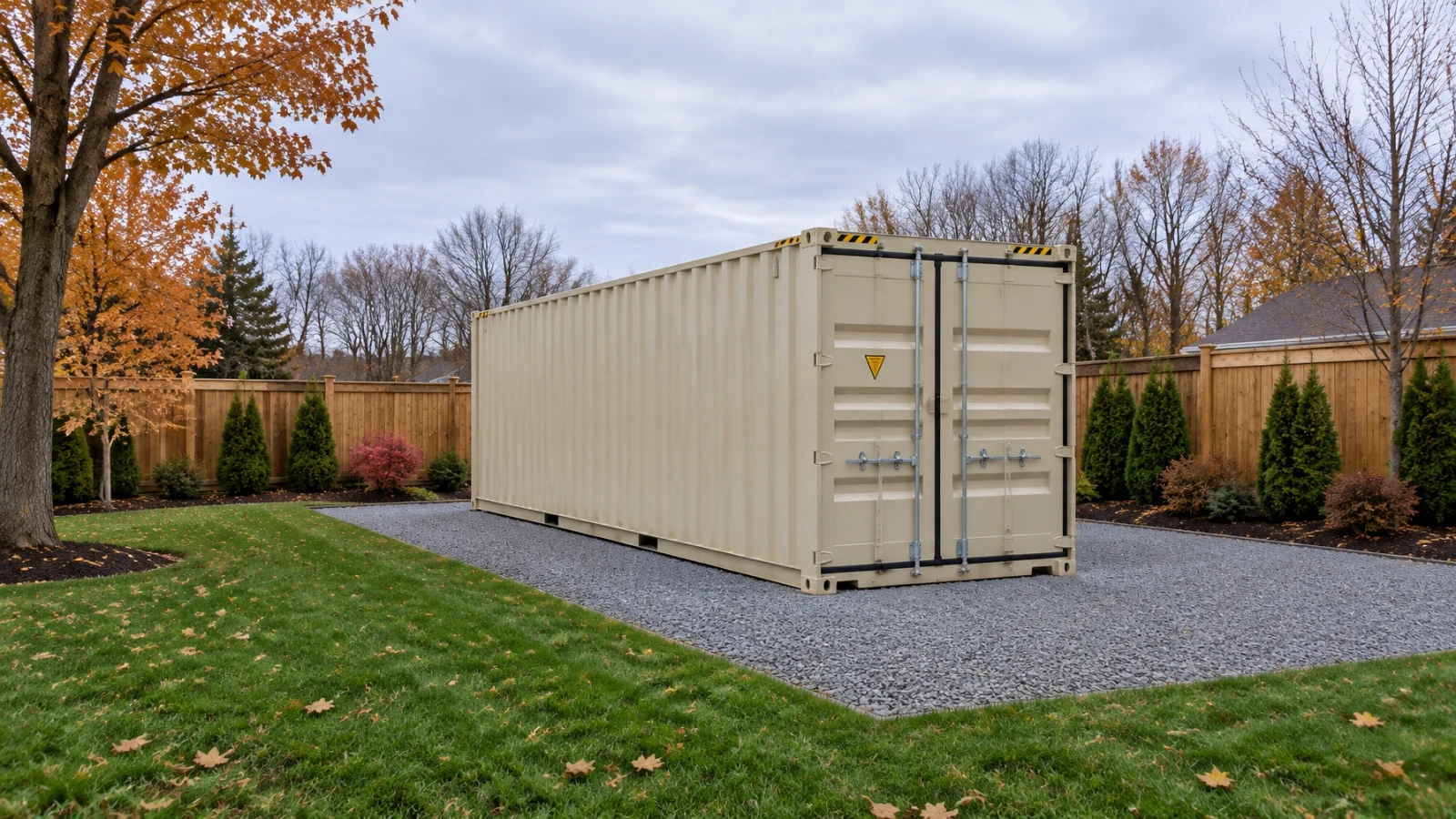
Short answer: usually yes, but never automatically. In Michigan, whether you can put a shipping container in your backyard depends on your local zoning ordinance, the size of your lot, how long the container stays, and what your HOA says. There is no statewide rule. A container that is perfectly legal on a five-acre property in Livingston County may be prohibited outright on a quarter-acre lot in Royal Oak. This guide walks through how Michigan municipalities classify containers, where placement tends to be allowed or restricted, what permits and setbacks to expect, and the exact steps to take before you order.
How Michigan Municipalities Classify Shipping Containers
Michigan delegates zoning authority to individual cities, villages, and townships, so the rules are set locally and vary widely. Before calling your building department, it helps to know which category your planned use falls into, because that determines the permit path.
Accessory structures. If the container will stay permanently and function like a shed or detached storage building, many townships treat it as an accessory structure. That usually means zoning approval, setback compliance, and sometimes a building permit. Some ordinances add screening requirements, such as painting or siding the container to match your home.
Temporary storage units. If the container is on-site for a defined period, for example during a move, renovation, or construction project, it often falls under temporary use rules. These typically cap how long it can stay (commonly somewhere between 14 and 90 days per year, depending on the municipality) and may require a simple temporary-use permit rather than full site-plan review.
Construction and job-site storage. Containers placed on active construction sites follow yet another path, often tied to the building permit already in play. If that is your situation, see our guide to containers on construction sites for the contractor-specific rules.
City vs. Township vs. HOA: Where the Rules Get Tighter
The same container can face completely different rules depending on where the property sits.
Rural townships (for example Livingston, Clinton, and St. Clair counties). Flexibility is generally highest here. Larger parcels, often five acres or more, frequently permit containers as permanent accessory buildings. Expect possible conditions: rear-yard-only placement, minimum setbacks (commonly 10 feet, sometimes more), and screening so the container blends with the principal structures. Some townships have written specific container ordinances; others handle them case by case, which is exactly why the phone call matters.
Suburban and urban cities (Detroit metro, Grand Rapids, Lansing). Rules tighten considerably. Many R-1 single-family zones prohibit permanent containers and allow only temporary placement, sometimes limited to paved driveways rather than grass or side yards. Cities like Royal Oak and Birmingham frequently ban permanent backyard containers outright. Duration limits of 14 to 90 days per calendar year are common.
Homeowners associations. HOA covenants are private rules, and they are often stricter than the underlying zoning. Many Michigan HOAs prohibit industrial or metallic outdoor structures regardless of what the township allows. Board approval, where permitted at all, is mandatory before delivery. An HOA can also enforce rules the township cannot, such as dictating placement, screening, or visibility from the street.
The practical takeaway: confirm three layers before ordering: your municipal zoning, any county or state road right-of-way considerations for delivery access, and your HOA or deed restrictions. The strictest of the three governs.
Permit Checklist and Placement Requirements
Before ordering a container, verify local requirements using this roadmap:
- Identify your jurisdiction. Is the property in a city, village, or township? Each sets its own rules, and township ordinances are often the most permissive.
- Check your zoning designation. Look up your parcel on the municipality's zoning map (R-1 single family, R-2, agricultural, and so on) and ask which container rules apply to that district.
- Ask the right questions. Call the building department and ask specifically: Are shipping containers allowed in my zoning district? Is a permit required? Are there time limits for temporary placement? What are the setbacks? Is screening required?
- Prepare a simple site plan if required. A sketch showing the container location, property lines, existing structures, and dimensions is often enough for temporary uses. Permanent placement may require more formal plans.
- Verify setbacks. Standard setbacks range from roughly 10 to 25 feet from property lines depending on the ordinance. Rear and side yard rules differ, so confirm which setback applies to your intended spot.
- Plan the base. Some municipalities require a gravel pad, concrete piers, or other stable foundation for permanent placement. Even where not required, a level, well-drained base prevents door misalignment and frame twist through Michigan freeze-thaw cycles. Our guide to container foundations covers the options in detail.
- Get it in writing. Rules and interpretations vary by clerk and by season. If you get approval verbally, follow up by email or request written confirmation so you have documentation if questions arise later.
What a Container Looks Like in Practice: Sizes and Grades for Backyard Use
If zoning allows a container, the next question is which unit fits your yard and your neighbors' sight lines.
- 20ft standard: 20 feet long, 8 feet wide, 8 feet 6 inches tall. About 4,850 pounds empty. The most common choice for residential driveways and side yards because it fits tighter spaces.
- 40ft standard: 40 feet long, 8 feet wide, 8 feet 6 inches tall. About 8,750 pounds empty. Doubles the storage for a modest footprint increase in length, but needs considerably more delivery clearance.
- 40ft High Cube: same footprint as the 40ft standard with a 9-foot 6-inch height. The extra foot matters for racking, tall equipment, or stacking totes.
- Used WWT (wind and watertight): secure, dry storage with cosmetic wear like dents and surface rust. The value pick, and a dark-colored or repainted used unit often blends into a backyard better than a bright new one.
- One-trip: near-new condition, ideal for high-visibility residential settings where appearance matters most.
For a full comparison, see our guide to choosing between new and used containers.
Delivery Logistics for Residential Lots
A backyard container still has to get there, and the delivery truck's needs shape which spot is actually feasible.
- Delivery cost: flat $575 delivery up to 100 miles, with freight calculated at checkout beyond 100 miles. Enter your ZIP code in our instant quote tool for exact pricing.
- Clearance: tilt-bed deliveries need a straight-line approach of roughly 90 feet for a 20ft container and 110 feet or more for a 40ft. Tight cul-de-sacs, narrow driveways, or gate widths under about 12 feet can make some placements impractical. Our site-prep checklist walks through the full delivery-day walkthrough.
- Surface: the drop spot should be level and firm. Gravel, asphalt, or concrete are preferred. Soft, muddy, or sloped ground can cause delivery refusal or door alignment problems later.
- Season: frozen Michigan ground in late fall and winter is often ideal for delivery, while spring thaw mud is not. Snow-covered sites need the route and drop spot plowed before the truck arrives.
Why Michigan Homeowners Choose Constable Containers
We are a Michigan-owned, family-run business, and we deal with local zoning questions, terrain, and weather every day.
- Transparent pricing: no hidden fees, and sales delivery is a flat $575 up to 100 miles with freight calculated at checkout beyond 100 miles.
- In-stock inventory: we maintain 20ft, 40ft, and 40ft High Cube units ready for dispatch to Flint, Lansing, Ann Arbor, and surrounding areas.
- Personal service: we help with container selection, placement advice, and site review before delivery day. Send us photos of your lot and we will flag access issues early.
- Quick delivery: same-day delivery may be available for orders placed by 10 AM; otherwise scheduling is typically 1 to 3 business days.
- Current promotion: ask about our limited-time $100-off offer on container purchases.
Your Action Plan
- Call your local building department and ask whether shipping containers are permitted in your zoning district, whether a permit is needed, and what the time limits and setbacks are.
- Check your HOA or deed restrictions before anything else if you have them. Private covenants are often stricter than zoning.
- Measure your site: the drop spot, the delivery approach (90 to 110+ feet of straight line), and overhead clearance (14 feet minimum).
- Plan the base: a level gravel pad or corner supports, with drainage away from the doors.
- Get an instant quote by entering your ZIP code, and confirm delivery details with us.
- Schedule delivery with a confirmed door orientation, and keep pets and kids clear on delivery day.
Enter your ZIP code for an instant quote, view all containers for sale, or contact us with site photos and questions. We will help you sort the zoning answer before you spend a dollar.
{“@type”:”BlogPosting”,”image”:”https://cdn.marblism.com/SN-X8I_P2vw.jpg”,”author”:{“name”:”Constable Containers”,”@type”:”Organization”},”@context”:”https://schema.org”,”headline”:”Can I Put a Shipping Container in My Backyard? Michigan Zoning Laws & Permits Explained”,”keywords”:”portable storage containers michigan, shipping container permits michigan, backyard shipping container laws”,”publisher”:{“logo”:{“url”:”https://constablecontainers.com/logo.png”,”@type”:”ImageObject”},”name”:”Constable Containers”,”@type”:”Organization”},”description”:”Comprehensive guide to Michigan shipping container zoning laws, permits, and residential placement rules for homeowners and businesses.”,”datePublished”:”2026-07-22″,”articleSection”:”Zoning and Permits”,”mainEntityOfPage”:{“@id”:”https://constablecontainers.com/blog/michigan-shipping-container-zoning-laws”,”@type”:”WebPage”}}